Category: CASES

  • 7 Debating Secrets to Win with Logic Every Time

    Mastering the Art of Debate: A Guide to Using Logic

    Introduction to Logical Debate

    Debating is a skill that can be applied in various aspects of life, from academic and professional settings to personal relationships and social interactions. Effective debate relies heavily on the ability to use logic, which is the process of using reason and sound argumentation to arrive at a conclusion. In this article, we will explore the essential components of logical debate, providing you with a comprehensive guide to improve your critical thinking and argumentation skills.

    Understanding Logical Debate

    Logical debate involves the use of reason, evidence, and sound argumentation to support a claim or position. It is a structured process that involves:

    • Identifying the issue or topic at hand
    • Presenting evidence and data to support your claim
    • Anticipating and responding to counterarguments
    • Engaging in respectful and constructive dialogue with your opponent

    Key Components of Logical Debate

    A well-structured debate requires several essential components. These include:

    • Claim:** A clear and concise statement of the position or argument you wish to support.
    • Warrant:** The underlying assumption or principle that justifies the claim.
    • Backing:** The evidence or data that supports the claim.
    • Qualifier:** A statement that acknowledges the limitations or potential flaws of the argument.

    Types of Arguments

    There are two primary types of arguments: deductive and inductive.

    • Deductive Argument:** A conclusion that is logically certain, given the premises.
    • Inductive Argument:** A conclusion that is probable, but not certain, given the premises.

    Using Logic in Debate

    To effectively use logic in debate, follow these steps:

    Step 1: Identify the Issue or Topic

    Clearly define the issue or topic at hand. This will help you to focus your argument and ensure that you are addressing the correct points.

    Step 2: Present Evidence and Data

    Support your claim with relevant evidence and data. This can include statistics, expert opinions, and historical examples.

    Step 3: Anticipate and Respond to Counterarguments

    Think critically about potential counterarguments and develop responses to address them. This will demonstrate your ability to engage with opposing viewpoints and strengthen your argument.

    Step 4: Engage in Respectful and Constructive Dialogue

    Maintain a respectful and open-minded attitude during the debate. This will help to foster a productive and engaging discussion.

    Common Fallacies in Debate

    Familiarize yourself with common fallacies that can undermine the validity of an argument. These include:

    • Ad Hominem:** Attacking the person making the argument rather than addressing the argument itself.
    • Straw Man:** Misrepresenting or exaggerating an opponent’s argument to make it easier to attack.
    • False Dichotomy:** Presenting only two options when, in fact, there are more.

    Developing Critical Thinking Skills

    Critical thinking is essential for effective debate. To develop your critical thinking skills, practice the following habits:

    • Ask Questions:** Encourage yourself to ask questions and challenge assumptions.
    • Seek Out Multiple Perspectives:** Expose yourself to diverse viewpoints and opinions.
    • Engage in Reflective Thinking:** Regularly reflect on your own thought processes and consider alternative explanations.

    Practical Tips for Debating with Logic

    To improve your debating skills, follow these practical tips:

    • Prepare Thoroughly:** Research the topic and anticipate potential counterarguments.
    • Listen Actively:** Pay attention to your opponent’s argument and respond thoughtfully.
    • Use Clear and Concise Language:** Avoid using jargon or complex terminology that may confuse your audience.

    Conclusion

    Effective debate relies on the ability to use logic and critical thinking. By understanding the essential components of logical debate, developing critical thinking skills, and avoiding common fallacies, you can improve your argumentation skills and engage in productive discussions. Remember to maintain a respectful and open-minded attitude during debate, and to always be prepared to defend your position with evidence and sound reasoning.

    FAQs

    What is the difference between a deductive and inductive argument?

    A deductive argument is a conclusion that is logically certain, given the premises. An inductive argument is a conclusion that is probable, but not certain, given the premises.

    How can I anticipate and respond to counterarguments?

    Think critically about potential counterarguments and develop responses to address them. This will demonstrate your ability to engage with opposing viewpoints and strengthen your argument.

    What are some common fallacies in debate?

    Common fallacies include Ad Hominem, Straw Man, and False Dichotomy. Familiarize yourself with these fallacies to avoid using them in your arguments.

    How can I develop my critical thinking skills?

    Practice asking questions, seeking out multiple perspectives, and engaging in reflective thinking. Regularly reflect on your own thought processes and consider alternative explanations.

    What are some practical tips for debating with logic?

    Prepare thoroughly, listen actively, and use clear and concise language. Avoid using jargon or complex terminology that may confuse your audience.

  • Unravel the Puzzle: 5 Steps to Tackle Even the Most Mind-Boggling Questions

    Breaking Down Complex Questions: A Step-by-Step Guide

    The Importance of Clear Communication

    Effective communication is the backbone of any successful relationship, whether personal or professional. When we’re faced with a complex question, it’s easy to get bogged down in the details and lose sight of the bigger picture. However, breaking down complex questions into manageable parts can help us communicate more effectively, avoid misunderstandings, and achieve our goals.

    No comments on Unravel the Puzzle: 5 Steps to Tackle Even the Most Mind-Boggling Questions
    No comments on Unravel the Puzzle: 5 Steps to Tackle Even the Most Mind-Boggling Questions

    Identifying the Root of the Problem

    The first step in breaking down a complex question is to identify the root of the problem. What is the main issue or concern that needs to be addressed? By pinpointing the core problem, you can begin to focus on the most critical aspects of the question and develop a clear plan to address it.

    Breaking Down the Question into Smaller Parts

    Once you’ve identified the root of the problem, it’s time to break down the question into smaller, more manageable parts. This can be done by asking yourself a series of questions, such as:

    • What are the key components of the question?
    • What are the most critical factors that need to be considered?
    • Are there any specific details or data that need to be taken into account?
    • Are there any potential roadblocks or obstacles that need to be addressed?

    By breaking down the question into smaller parts, you can begin to develop a clear and concise plan to address the issue.

    Identifying the Key Players Involved

    Another crucial step in breaking down a complex question is to identify the key players involved. Who are the stakeholders, decision-makers, or influencers that need to be considered? By understanding the roles and responsibilities of each individual, you can develop a plan that takes into account their needs, concerns, and input.

    Developing a Clear and Concise Plan

    With the root of the problem identified and the question broken down into smaller parts, it’s time to develop a clear and concise plan to address the issue. This plan should include specific goals, objectives, and timelines, as well as a clear understanding of the roles and responsibilities of each individual involved.

    Implementing the Plan and Monitoring Progress

    Finally, it’s time to implement the plan and monitor progress. This involves regular check-ins, feedback loops, and adjustments to the plan as needed. By staying focused and committed to the plan, you can ensure that the complex question is addressed effectively and efficiently.

    The Benefits of Breaking Down Complex Questions

    Breaking down complex questions has numerous benefits, including:

    • Improved communication and understanding
    • Increased efficiency and productivity
    • Reduced misunderstandings and conflicts
    • Enhanced decision-making and problem-solving skills

    Conclusion

    Breaking down complex questions is a critical skill that can be applied in a wide range of situations, from personal relationships to professional settings. By identifying the root of the problem, breaking down the question into smaller parts, identifying the key players involved, developing a clear and concise plan, and implementing the plan and monitoring progress, you can achieve your goals and communicate more effectively.

    Practical Tips and Strategies

    Q: What if the question is too broad or vague?

    A: In cases where the question is too broad or vague, it’s essential to clarify the scope and focus of the question. Ask yourself, “What is the specific issue or concern that needs to be addressed?” and “What are the key components of the question?” By narrowing down the question, you can develop a more focused and effective plan to address the issue.

    Q: How do I know when to break down a question into smaller parts?

    A: Breaking down a question into smaller parts is often a matter of instinct and experience. However, some common indicators that a question may need to be broken down include:

    • The question is too complex or convoluted
    • The question involves multiple stakeholders or decision-makers
    • The question requires a high level of detail or analysis
    • The question involves a high level of risk or uncertainty

    By being aware of these indicators, you can proactively break down complex questions and develop a clear and concise plan to address the issue.

    Q: What if the key players involved are not available or accessible?

    A: In cases where the key players involved are not available or accessible, it’s essential to develop a plan that takes into account their roles and responsibilities, even if they are not directly involved. This may involve working with their representatives, delegates, or proxies to ensure that their needs and concerns are taken into account.

    Q: How do I know when to seek additional help or support?

    A: Seeking additional help or support is often a sign of strength, not weakness. If you’re struggling to break down a complex question or develop a clear and concise plan, don’t hesitate to seek guidance from colleagues, mentors, or experts in the field. By being open to support and guidance, you can ensure that the complex question is addressed effectively and efficiently.

  • When the Answer is “I Don’t Know”: How to Make Decisions with Incomplete Data

    When the Answer is “I Don’t Know”: How to Make Decisions with Incomplete Data

    Decision Making With Incomplete Information

    The Challenge of Making Decisions with Imperfect Data

    Decision making is a crucial aspect of human life, and it’s essential to make informed decisions that align with our goals and values. However, in many situations, we’re faced with incomplete information, which can make decision making a daunting task. Incomplete information can arise from various sources, such as limited data, uncertain predictions, or incomplete knowledge about the situation. In this article, we’ll explore the challenges of making decisions with incomplete information, the consequences of relying solely on intuition, and practical strategies for making informed decisions in uncertain environments.

    No comments on When the Answer is “I Don’t Know”: How to Make Decisions with Incomplete Data
    No comments on When the Answer is “I Don’t Know”: How to Make Decisions with Incomplete Data

    The Dangers of Relying on Intuition

    Intuition is a powerful tool that can guide our decision-making process, but it’s not foolproof. Relying solely on intuition can lead to suboptimal decisions, as it’s often based on incomplete information and biases. When we’re faced with incomplete information, our intuition may try to fill the gaps, but it can also lead us astray. Our brain is wired to recognize patterns, and in the absence of concrete data, it may create patterns that don’t exist. This can result in a phenomenon known as the “availability heuristic,” where we overestimate the likelihood of an event based on how easily examples come to mind. By relying on intuition, we risk making decisions that may not be in our best interests.

    The Consequences of Incomplete Information

    Incomplete information can lead to a range of consequences, from minor setbacks to catastrophic outcomes. In business, for example, incomplete information can result in missed opportunities, inefficient resource allocation, or even financial ruin. In personal life, incomplete information can lead to poor relationships, health problems, or financial instability. The consequences of incomplete information can be severe, and it’s essential to develop strategies for making informed decisions in uncertain environments.

    Strategies for Making Decisions with Incomplete Information

    Despite the challenges of incomplete information, there are several strategies that can help us make informed decisions. Here are a few:

    1. Seek Out Diverse Perspectives Seeking out diverse perspectives can help us gather more information and make more informed decisions. This can involve consulting with experts, conducting research, or simply engaging with people from different backgrounds. By exposing ourselves to diverse perspectives, we can identify potential biases and develop a more comprehensive understanding of the situation.

    2. Use Probability and Statistics Probability and statistics can help us quantify uncertainty and make more informed decisions. By analyzing data and using statistical models, we can estimate the likelihood of different outcomes and make more informed decisions. This can involve using probability distributions, such as the normal distribution or the binomial distribution, to model uncertainty.

    3. Use Decision Trees Decision trees are a useful tool for making decisions with incomplete information. A decision tree is a flowchart that represents a series of decisions and their possible outcomes. By using a decision tree, we can visualize the possible outcomes of a decision and make more informed choices.

    4. Use Sensitivity Analysis Sensitivity analysis involves analyzing how different variables affect a decision. By using sensitivity analysis, we can identify which variables have the greatest impact on a decision and make more informed choices. This can involve using techniques such as scenario planning or sensitivity analysis to model uncertainty.

    Conclusion

    Making decisions with incomplete information is a challenging task, but it’s not impossible. By seeking out diverse perspectives, using probability and statistics, decision trees, and sensitivity analysis, we can make more informed decisions in uncertain environments. It’s essential to recognize the limitations of our knowledge and be willing to adapt and learn from experience. By developing these strategies, we can make more informed decisions and achieve our goals, even in the face of incomplete information.

    FAQs

    Q: How can I avoid relying on intuition when making decisions?

    A: One way to avoid relying on intuition is to seek out diverse perspectives and gather more information. This can involve consulting with experts, conducting research, or simply engaging with people from different backgrounds. By exposing ourselves to diverse perspectives, we can identify potential biases and develop a more comprehensive understanding of the situation.

    Q: What is the difference between incomplete information and uncertainty?

    A: Incomplete information refers to a lack of data or knowledge about a situation. Uncertainty, on the other hand, refers to the unknown or unpredictable nature of a situation. While incomplete information can lead to uncertainty, not all uncertainty is due to incomplete information. It’s essential to distinguish between the two and develop strategies for making decisions in uncertain environments.

    Q: How can I use decision trees to make more informed decisions?

    A: Decision trees are a useful tool for making decisions with incomplete information. By using a decision tree, we can visualize the possible outcomes of a decision and make more informed choices. This can involve using techniques such as scenario planning or sensitivity analysis to model uncertainty and identify the most likely outcomes.

    Q: What are the consequences of relying on intuition when making decisions?

    A: Relying on intuition can lead to suboptimal decisions, as it’s often based on incomplete information and biases. Our brain is wired to recognize patterns, and in the absence of concrete data, it may create patterns that don’t exist. This can result in a phenomenon known as the “availability heuristic,” where we overestimate the likelihood of an event based on how easily examples come to mind.

  • 10 Verdict Logic Tricks to Win Your Next Case

    10 Verdict Logic Tricks to Win Your Next Case

    Unlocking the Power of Verdict Logic: A Comprehensive Guide

    Introduction

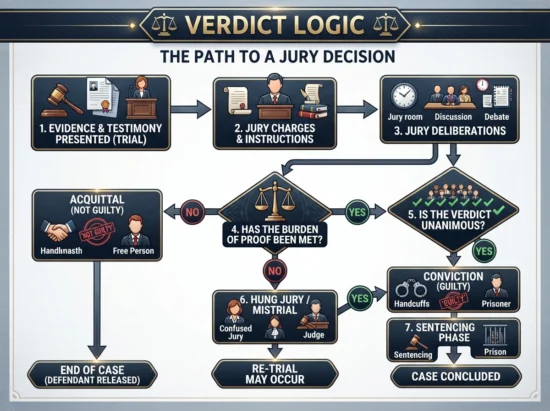
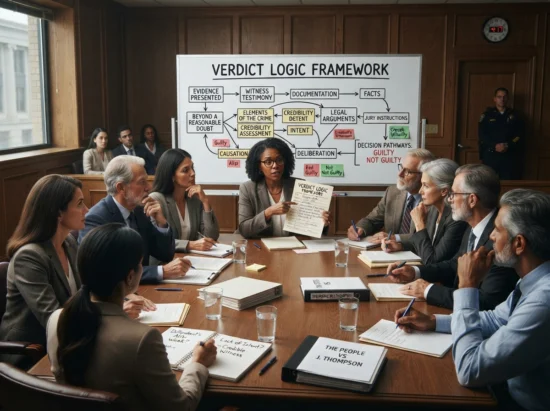
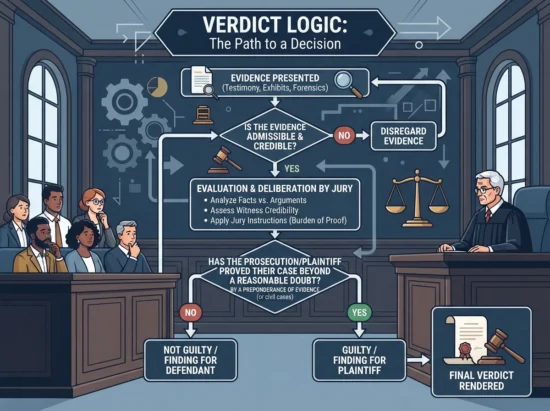
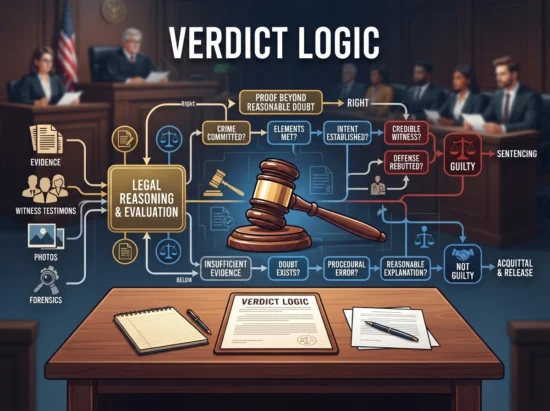
    Verdict logic, also known as deductive logic, is a fundamental concept in critical thinking, problem-solving, and decision-making. It involves evaluating evidence, identifying patterns, and drawing conclusions based on the available information. Effective use of verdict logic can help individuals and organizations make informed decisions, resolve conflicts, and achieve their goals. In this article, we will explore the principles and techniques of verdict logic, providing a comprehensive guide to its effective application.

    The Fundamentals of Verdict Logic

    Verdict logic is based on the following principles:

    • Clear definition of terms: Verdict logic starts with a clear understanding of the terms and concepts involved in the decision-making process.
    • Accurate observation of facts: Verdict logic requires the collection and analysis of accurate, relevant facts to inform the decision-making process.
    • Logical reasoning: Verdict logic involves the use of logical reasoning to evaluate the evidence, identify patterns, and draw conclusions.
    • Systematic evaluation: Verdict logic involves a systematic evaluation of the evidence, considering all relevant factors and potential biases.

    The Steps of Verdict Logic

    Verdict logic involves a series of steps that help to evaluate evidence, identify patterns, and draw conclusions:

    • Define the problem or question: Clearly define the problem or question to be addressed.
    • Collect relevant evidence: Gather and evaluate all relevant evidence related to the problem or question.
    • Identify patterns and relationships: Look for patterns, relationships, and potential biases in the evidence.
    • Evaluate the evidence: Use logical reasoning to evaluate the evidence, considering all relevant factors and potential biases.
    • DRAW A CONCLUSION: Draw a conclusion based on the evidence and logical reasoning.

    Common Pitfalls and Biases

    Verdict logic can be affected by various biases and pitfalls, including:

    • Confirmation bias: The tendency to seek out information that confirms one’s pre-existing beliefs.
    • Availability heuristic: Overestimating the importance or likelihood of information based on how easily it comes to mind.
    • Anchoring effect: Relying too heavily on the first piece of information encountered, even if it is not representative of the overall data.
    • Groupthink: The tendency to conform to a group’s decision or opinion, even if it is not well-reasoned.

    Strategies for Overcoming Biases and Pitfalls

    Several strategies can help to overcome biases and pitfalls in verdict logic:

    • Seek out diverse perspectives: Encourage input from a variety of sources and perspectives to minimize confirmation bias and groupthink.
    • Use evidence-based reasoning: Rely on empirical evidence and logical reasoning to inform decision-making, rather than relying on intuition or personal biases.
    • Encourage critical thinking: Foster a culture of critical thinking and skepticism, where individuals are encouraged to question assumptions and challenge prevailing views.
    • Use decision-making tools: Utilize decision-making tools, such as decision trees or cost-benefit analysis, to help structure the decision-making process and minimize biases.

    Real-World Applications of Verdict Logic

    Verdict logic has numerous real-world applications, including:

    • Medical diagnosis: Verdict logic is used in medical diagnosis to evaluate symptoms, test results, and patient history to arrive at a diagnosis.
    • Criminal justice: Verdict logic is used in the criminal justice system to evaluate evidence, identify patterns, and draw conclusions about guilt or innocence.
    • Business decision-making: Verdict logic is used in business decision-making to evaluate market trends, customer feedback, and financial data to inform strategic decisions.
    • Academic research: Verdict logic is used in academic research to evaluate evidence, identify patterns, and draw conclusions about research findings.

    Conclusion

    Verdict logic is a powerful tool for making informed decisions, resolving conflicts, and achieving goals. By understanding the principles and techniques of verdict logic, individuals and organizations can improve their critical thinking skills, overcome biases and pitfalls, and make better decisions. Effective use of verdict logic can help to build trust, credibility, and reputation, and is essential for success in a wide range of contexts.

    FAQs

    What is the difference between verdict logic and inductive logic?

    Verdict logic and inductive logic are related but distinct concepts. Verdict logic involves evaluating evidence to draw a conclusion about a specific case or situation, whereas inductive logic involves drawing a general conclusion based on a set of specific instances.

    How can I improve my verdict logic skills?

    Improving verdict logic skills requires practice, patience, and persistence. Start by identifying the principles and techniques of verdict logic, and then practice applying them in real-world situations. Seek out feedback from others, and engage in critical thinking exercises to help develop your skills.

    Can verdict logic be used in creative fields, such as art or design?

    Yes, verdict logic can be applied in creative fields, such as art or design. By evaluating evidence and identifying patterns, artists and designers can make informed decisions about their work, and create more effective and compelling designs.

    How can I use verdict logic to resolve conflicts?

    Verdict logic can be used to resolve conflicts by evaluating evidence, identifying patterns, and drawing conclusions about the underlying causes of the conflict. By applying verdict logic, individuals and organizations can identify areas of agreement, and develop more effective solutions to resolve the conflict.